If you have read the Bible for years and still could not explain how it all fits together, this will be the most important page you read this year.
Not because there is something wrong with you. Because nobody ever handed you the map.
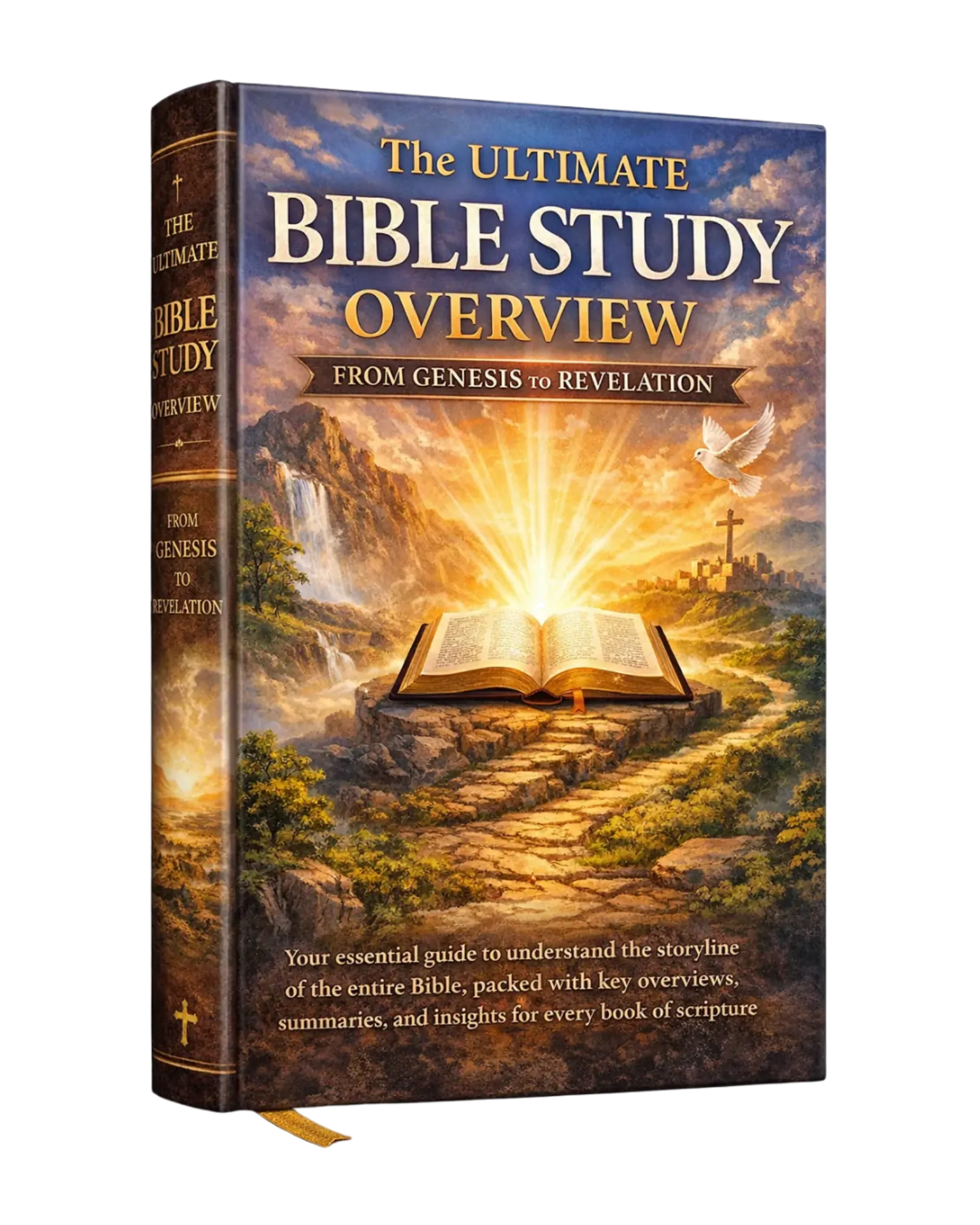
Dear friend,
I want to tell you about the night I sat down on my kitchen floor.
It was late. Everyone was asleep. I had a Bible open in front of me, a legal pad covered in arrows and crossed-out lines, and fifteen years of reading behind me.
And I had just realised I could not answer a simple question.
What is the book of Leviticus doing in the Bible?
Not “what is it about.” I could have told you it was about offerings and priests. I mean: what is it doing there? Why did God put it between the rescue from Egypt and the walk to the Promised Land? What breaks if you take it out?
I did not know.
And once that question was in my head, others followed. Why does Chronicles repeat Kings? What is Obadiah for — twenty-one verses about a nation nobody remembers? Why does Paul write a private letter about a runaway slave, and why is it in my Bible?
I had read all of it. Some of it many times. And I could not tell you the shape of any of it.
If you have ever felt that — the quiet, slightly embarrassing feeling of owning a book you love and not understanding it — then keep reading. Because what I found on the other side of that night changed how I open my Bible every single morning.
It is not your fault.
You were not taught to read the Bible. You were taught to read parts of it.
Think about how it actually happened. Sunday school gave you stories — Noah, David, Daniel, Jonah. Sermons gave you passages, one at a time, usually from the same twelve books. Devotionals gave you a verse a day with a paragraph attached. A reading plan gave you three chapters a morning until you hit Leviticus in February and quietly stopped.
Every one of those is good. Not one of them shows you the shape.
It is like being handed a thousand-piece puzzle one piece at a time, over twenty years, and never once being shown the picture on the box.
You end up knowing a great deal and understanding very little. You can quote the verse and not place it. You can love the book and not read it.
And here is the part that stings: most Christians in your church are in exactly the same position. They just do not say it out loud either.
Everything you tried works on pieces.
They buy a study Bible. Two thousand pages of footnotes at the bottom of every page. Wonderful for a verse. Useless for a shape. Footnotes explain the tree; they never show you the forest.
They start a reading plan. January first, Genesis one. It works beautifully for six weeks. Then Leviticus. Then Numbers. Then the guilt, then the quiet stop, then next January.
They buy a devotional. One page a day, a warm thought, a verse. Comforting — and completely disconnected from the book before it and the book after it.
They ask the pastor. He answers well. Then Sunday ends and you are back where you were.
Do you see the pattern? Every one of those tools works on pieces. Not one of them was built to show you the whole.
You do not have a discipline problem. You do not have an intelligence problem. You have a map problem. And no amount of reading harder fixes a missing map.
There is one thread running through all of it.
Back to the kitchen floor.
What I started doing that night — and kept doing for years, at kitchen tables and in parked cars and on lunch breaks — was simple and slow.
I stopped reading the Bible for content and started reading it for position. For every book I asked four questions: What is this doing here? What comes before it? What comes after it? And where, in this book, is Christ?
Sixty-six books. Four questions each. Years of it.
And somewhere in the middle of that, I saw something I have never been able to unsee.
It begins in Genesis chapter three, in the worst moment in human history, when God turns to a serpent and promises that a seed of the woman will crush his head. That is the first promise of a Rescuer, and it is made before Adam and Eve have even left the garden.
From there you can follow it. Watch:
A ram caught in a thicket on Mount Moriah, dying in the place of a son.
A lamb without blemish, its blood on a doorpost, and death passing over the house.
A rock struck in the wilderness, and water pouring out for a people who did not deserve it.
A scarlet cord hanging from a window in Jericho, and one house spared.
A high priest carrying twelve names over his heart into the presence of God.
A servant in Isaiah fifty-three, wounded for transgressions that were not his.
A throne promised to David that no son of David could hold — until one did.
Every one of those is the same thread. And it runs straight through Bethlehem, straight through a cross outside Jerusalem, and it ends on a throne in Revelation twenty-two, in a restored garden with the same tree of life that was lost in Genesis three.
The Bible is not sixty-six books about God. It is one story about one Person, told sixty-six times.
And once you see the thread, Leviticus stops being filler. Obadiah stops being obscure. Philemon stops being a curiosity. Every book has a job, and every book is doing it.
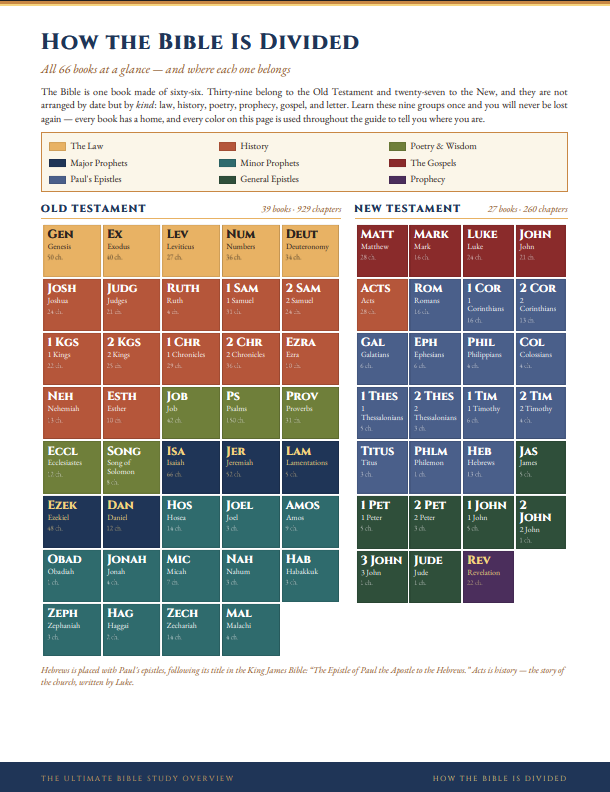
See the whole thread — all 66 books, laid out the same way
The Ultimate Bible Study Overview · 217 pages · King James · $25
The same structure, on all sixty-six.
Now, seeing it is one thing. Being able to use it every morning is another.
So I did the only thing I knew how to do. I wrote it down. Every book. The same way, every time.
Here is exactly what that looks like. Open the guide to any of the sixty-six books and you will find the same structure on the page:
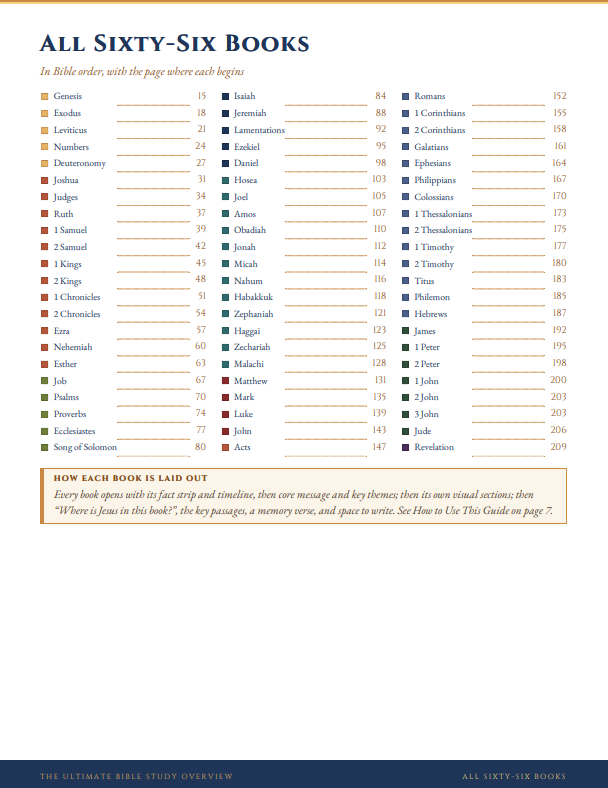
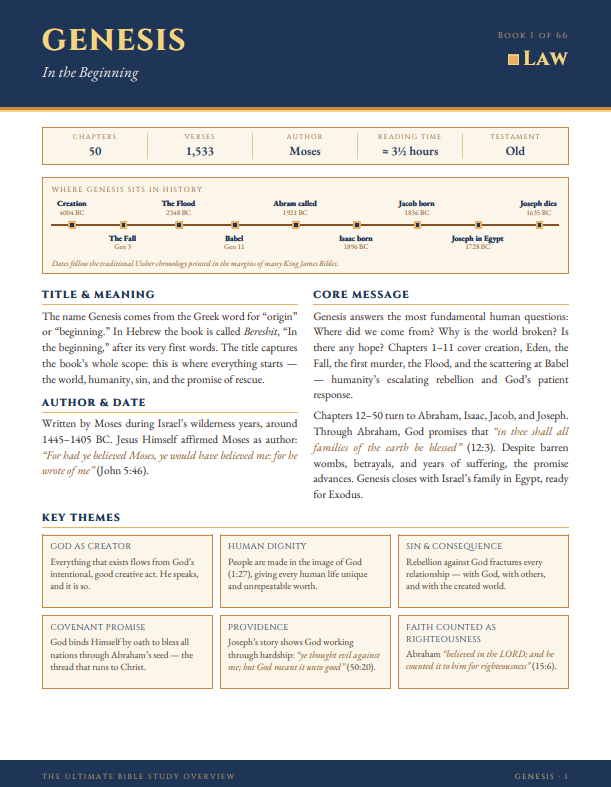
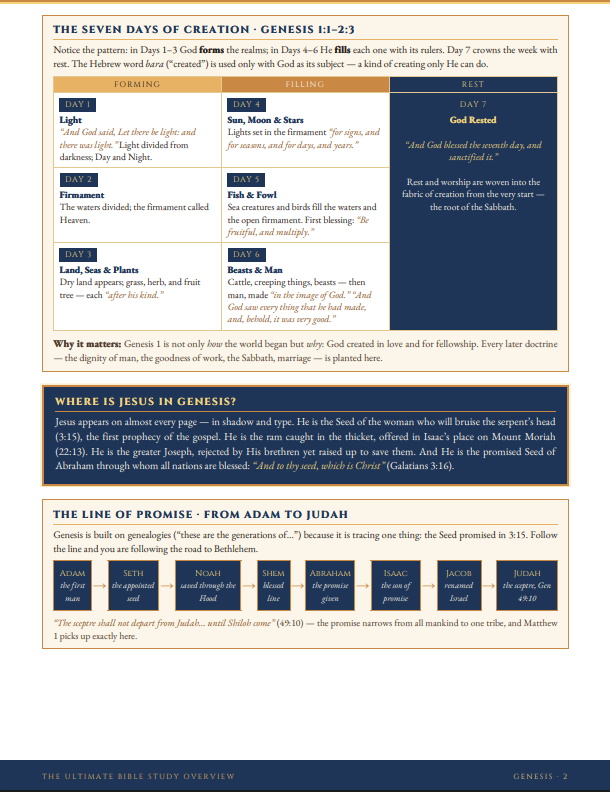
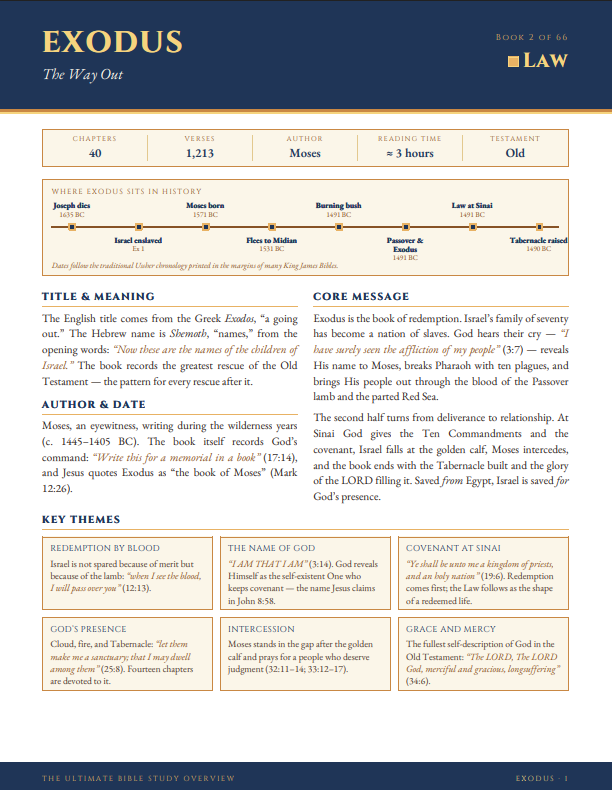
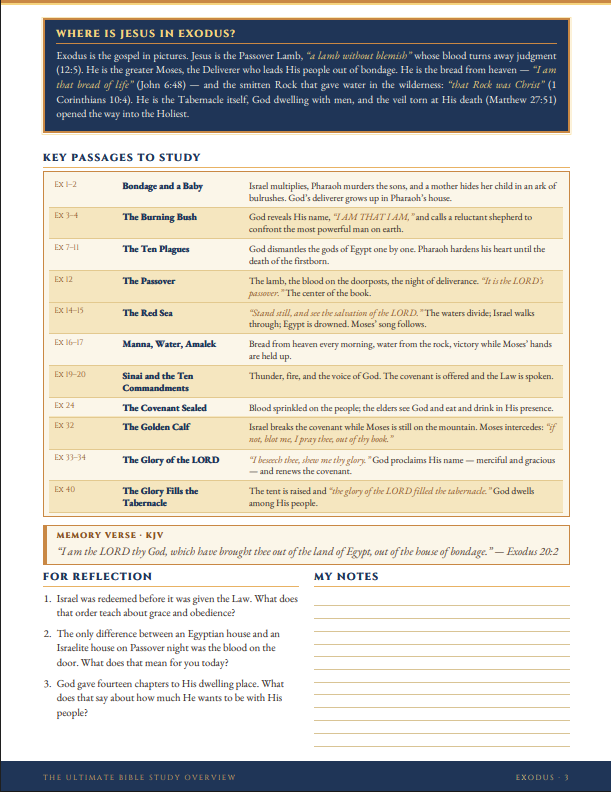
The fact strip. How many chapters, how many verses, who wrote it, when, and how long it takes to read. Ten seconds and you are oriented.
The timeline. Where this book sits in four thousand years of real history — what has just happened, what is about to happen. This is the piece almost nobody has, and it is the piece that makes everything else make sense.
The core message. What this book is doing in the story, in plain English. Not a summary of the plot. The purpose.
Six key themes. What to watch for while you read, so you are not just moving your eyes down the page.
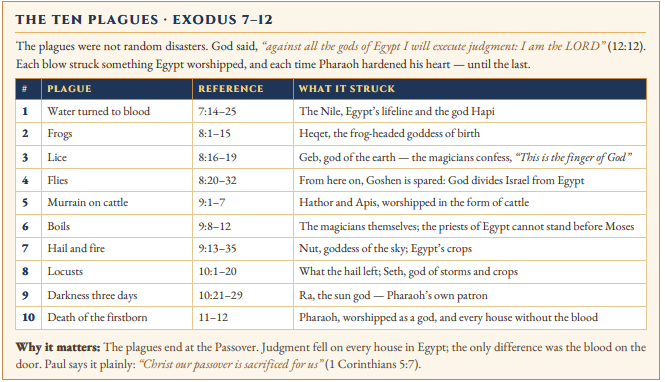
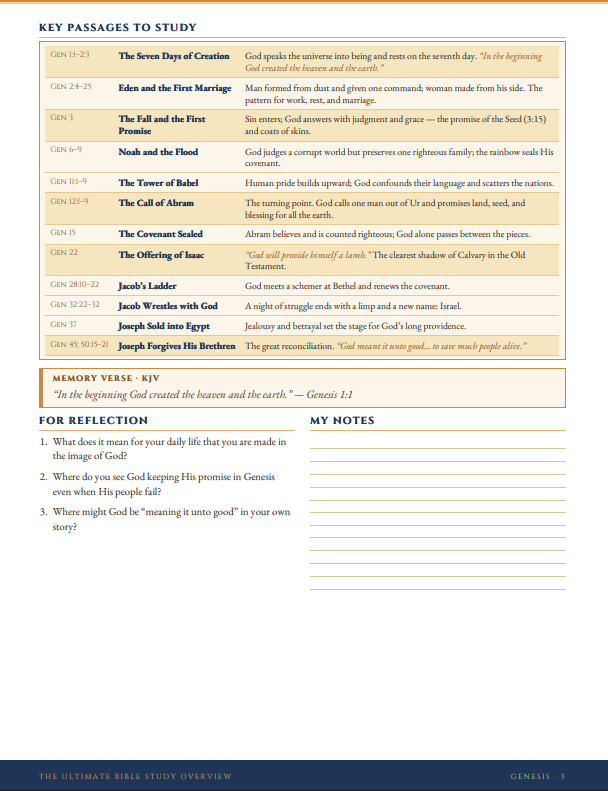
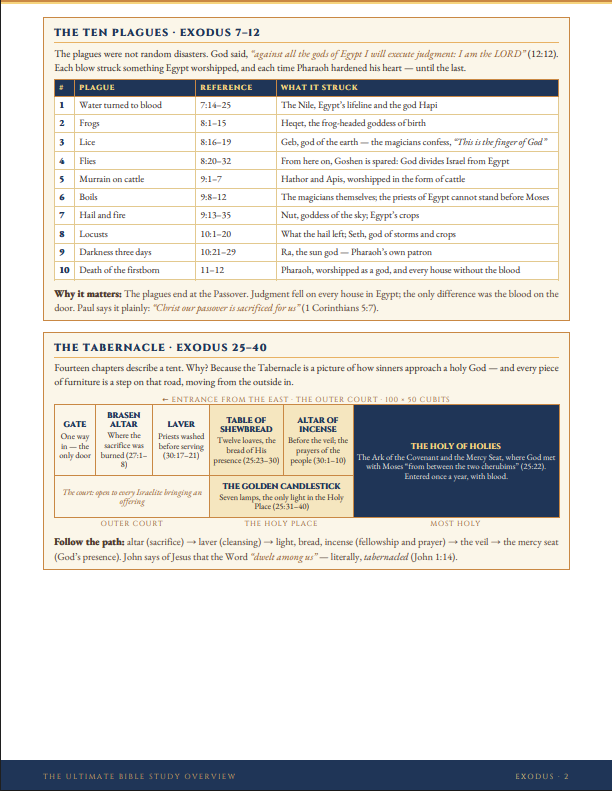
The charts. Built for each book alone. The ten plagues and the Egyptian god each one struck. The forty kings of Israel and Judah with Scripture’s verdict on every man. The Tabernacle, piece by piece, from the gate to the mercy seat. The seven churches, and the promise made to each overcomer.
“Where is Jesus in this book?” In all sixty-six. Not just the easy ones. Open it at Leviticus — He is there. Open it at Obadiah — He is there. Open it at Nahum, at Ezra, at Second John — He is there, and the guide shows you where.
The key passages. The chapters that matter most in that book, marked, so you know where to start when you only have twenty minutes.
A memory verse, three questions, and space to write.
Learn that pattern once and it works on every book you will ever open. That is the whole design.
Open it at the book you like least.
I am not going to pretend to be something I am not.
I am not a pastor. I am not a theologian. I have no seminary degree and no letters after my name.
I am a Christian who wanted to understand Scripture more clearly than he did, and who was too stubborn to give up on the question.
What I do have is the work. Years of it. Every verse in this guide is the Authorized King James Version — nothing paraphrased, nothing modernised, nothing softened. The dates follow the traditional Ussher chronology printed in the margins of King James Bibles for over three centuries. Where faithful Christians have read a passage in different ways — Revelation, most of all — I lay the readings side by side and let you weigh them, instead of telling you which one to hold.
And here is the honest test of whether a guide like this is any good: open it at the book you like least.
Anyone can write three interesting pages on John. Try Leviticus. Try Numbers. Try Zephaniah. That is where a guide either earns its place on your shelf or does not.
Mine was built for exactly those books, because those are the books that made me sit down on the kitchen floor in the first place.
I studied the Bible for years. Fatherhood gave that work a purpose.
There is one more thing you should know, and then I will get out of your way.
For years, all of this stayed in notebooks. It was mine. I never once thought about doing anything with it.
Then I found out I was going to be a father.
Twins. They are here now — small, and loud, and the best thing that has ever happened to me.
And the day I learned they were coming, two things landed on me at the same time. That from here on everything would be harder, and that the only thing I had worth giving was the very thing I had been keeping to myself.
Because one day they are going to ask me what the Bible means. Not “tell me a Bible story” — they will get plenty of those. I mean the real question, the one that comes at fourteen or nineteen or twenty-six: what is this book, and why should I believe it, and what does it have to do with me?
I wanted to have an answer. Not a shrug. Not “ask the pastor.” An answer, in my own words, that I could stand behind.
So I took the notebooks and I built this.
There are easier things to sell than a Bible study guide. Most of them I would be ashamed to put my name on. I wanted the work that feeds my children to be work I am not embarrassed to explain to them one day.
This is it.
— Christian S.
Take it with you — Genesis to Revelation
217 pages · All 66 books · King James Version
Everything you get, the moment you order.
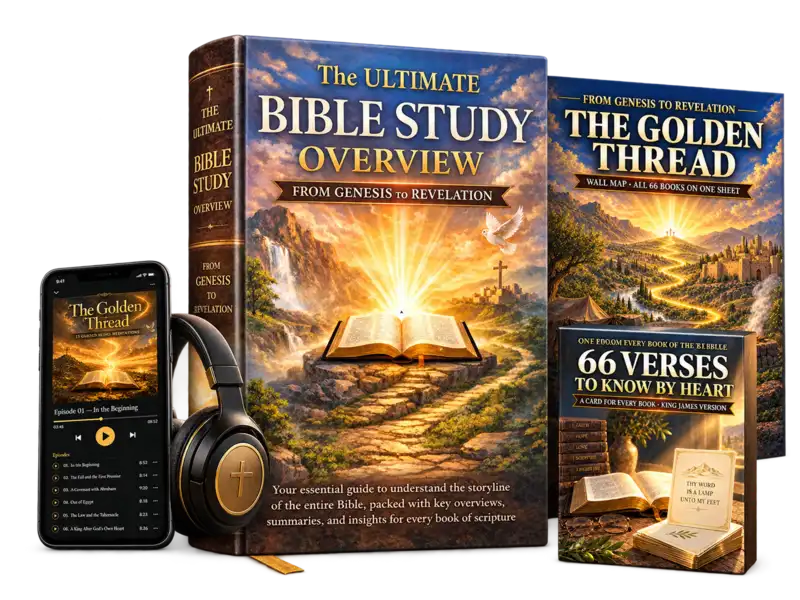
The Ultimate Bible Study Overview — 217 pages.
All sixty-six books, each laid out the way I described above. Charts, timelines, core messages, key passages, memory verses, questions, and “Where is Jesus in this book?” in every single one. Plus the front matter: how the Bible is divided, where to start reading, the whole Bible on one timeline, a one-year reading plan, and a sixty-six book checklist for the back.
And three things I am including at no extra cost, because they make the guide work better:
🎁 The Golden Thread — 15 Audio Lessons. (a $14 value — free)
For the drive, the walk, the kitchen. The thread, spoken.
🎁 The Golden Thread Map. (a $12 value — free)
Four thousand years, four movements, sixty-six books — the whole story on one page you can keep beside whatever you are reading.
🎁 66 Verses to Know by Heart. (a $12 value — free)
One verse from every book, with a short reflection and four proven ways to commit it to memory.
Total value: $85. Yours today for $25.
You pay for the book. The three come with it.
Thirty days. And you keep everything.

I want to make this as easy as I can for you.
Take thirty days. Read the whole thing. Listen to every meditation. Print the map. Mark it up.
If at any point in those thirty days the Bible has not started to fit together for you, reply to your receipt with one line and I will refund every cent. No form. No questions. No “let me see if I can change your mind.”
And you keep everything. The book, the audio, the map, the cards. All of it.
I would rather lose $25 than have you feel you wasted it.
You have the whole map now. Or you can keep reading it in pieces.
Here is where we are.
You have read the Bible for years. You know the stories. You love the book.
And there is a shape to it that nobody has shown you — not because it was hidden, but because nobody ever sat down and drew it out for you, book by book, from the first page to the last.
I sat down and drew it. It took years. It is 217 pages. It is yours tonight for $25, and if it does not do for you what it did for me, I will give the money back and you keep it anyway.
“And beginning at Moses and all the prophets, he expounded unto them in all the scriptures the things concerning himself.” — Luke 24:27
That is what He did on the road to Emmaus. Two men who had read those Scriptures their whole lives, and He walked them through the whole thing and showed them where He was in it.
I am not Him and this is not that. But it is the closest thing I know how to build.
— Christian S.
Instant access · 217 pages · $25 one-time · 30-day “keep everything” guarantee
Every purchase supports a Christian family.